In October 2024, Mark Zuckerberg claimed he was near grandmaster level at Civilization VI and reckoned, “I’d be surprised if anyone in the world could beat me at that.” His wife Priscilla’s reaction, “Wait, you’ve played this game for over 1,000 hours?” captured something universal.
Civilization is Sid Meier’s legendary turn-based strategy game in which you take a single civilization from the Stone Age to the Space Age. Each turn you make decisions about research, city-building, diplomacy, war, and culture. The game is deliberately designed so that something is always about to finish: a new technology, a wonder, or a unit. It creates an irresistible “just one more turn” compulsion (a.k.a. JOMT). You sit down for a quick session as Julius Caesar or Queen Victoria only to surface hours later looking like Charlie Sheen or Lindsay Lohan after a bender, still chasing the next breakthrough. The game developer Firaxis leans into the compulsion so deliberately that “One More Turn” became an explicit post-victory option.
Product development runs on the same seductive loop: continuous discovery, incremental wins, and the perpetual sense that the perfect outcome sits just two iterations away. Civilization is not mere entertainment. It is a near-perfect simulation of how product teams quietly undermine themselves through endless, rewarding, yet ultimately self-defeating progress.
The newest promise is that agentic AI will change everything after one perfect prompt, one perfect deliverable, and job done. The hard reality is that working with agentic AI tools is still hard work. Civilization shows us why agentic AI is not going to take all our jobs. The real traps in god-mode AI product development require human judgment, discipline, and the courage to say “enough.” AI makes the addictive loops easier, not obsolete.
The dopamine loop and iteration without end.
Civilization masters variable rewards. Every turn teases visible progress: a building completes in three turns, a spy mission advances, a new policy unlocks. Victory always feels two smart decisions away. You tell yourself “just one more turn.”
Product development runs the same cycle. One more A/B test. One more PRD revision. One more stakeholder alignment pass. The result is the feature factory: constant micro-improvements that can delay a meaningful launch without sober judgement.
Agentic AI promises a “one-shot” workflow. Instead it delivers infinite frictionless iterations. The tool removes the old forcing functions (time, cost, annoyance). The myth of the one-shot makes the dopamine loop stronger, not weaker.
Yet the tools drive two addictive and opposing errors in human judgement: the belief we can do more than our experience and abilities; and the self-doubt about our ability to identify errors. Your preferred AI agent asking “would you like me to refine this further?” can chew up tokens faster than $20 bills in a poker machine after a couple of pints at the casino. Thankfully, most frontier models now build in helpful judgement calls like “If it helps the decision, I think version n is shippable as-is.” Your favourite AI drinking buddy now says last drinks, time to call an Uber and head home.
Over-expansion and the cost of saying yes.
Early Civ is liberating. Settle cities. Claim luxuries. Snowball. By the industrial era, you’re micromanaging twenty cities, happiness has collapsed, and your elegant strategy is buried under administrative overhead.
The product equivalent is surface-area sprawl. Just one more vertical. Just one more persona. Just enterprise too. The roadmap balloons, engineering velocity drops, context-switching compounds, tech debt eats the next two quarters. The taller-versus-wider question in Civ, go deep on a few cities or expand wide, has a direct analogue in product strategy, and the wrong answer at the wrong stage is fatal.
Your latest agentic AI tool makes over-expansion feel painless. Research feels infinite. Administrative overhead shrinks. “Let’s just add one more module” no longer hurts in the moment because the AI can generate supporting analysis instantly. The myth of the one-shot makes every new idea feel low-risk, until the product collapses under its own weight. Human discipline is still required to say “no” and protect focus.
In the May 6 2026 HBR article “Research: Why You Shouldn’t Treat AI Agents Like Employees,” the authors showed that when AI agents are anthropomorphized as coworkers, participants explicitly referenced questioning their own skills, doubting whether they had identified all issues, or feeling the need to re-verify work they would typically accept at face value.
The wrong victory condition: sunk costs and metric myopia.
Civ offers multiple paths to victory: science, culture, domination, diplomacy, religion. Players often lock in one early, then discover mid-game that the map, the neighbours, or sheer luck favour another. Sunk-cost fallacy keeps them grinding the wrong tech tree anyway.
Product teams do this constantly. They commit to a North Star metric, the market shifts, and they keep optimising for the wrong thing because the org has built momentum around it. Vanity metrics persist long after they’ve stopped predicting outcomes. Roadmaps become religious crusades rather than adaptive strategies.
Agentic AI makes the wrong path dangerously easy to double down on. One prompt gives you beautifully formatted analysis that justifies staying the course. The myth of the one-shot turns sunk-cost fallacy into perfectly documented, AI-polished delusion. Human judgment is still required to look at the board state and say: this isn’t the game I’m in anymore.
Late-game stagnation: when iteration becomes drudgery.
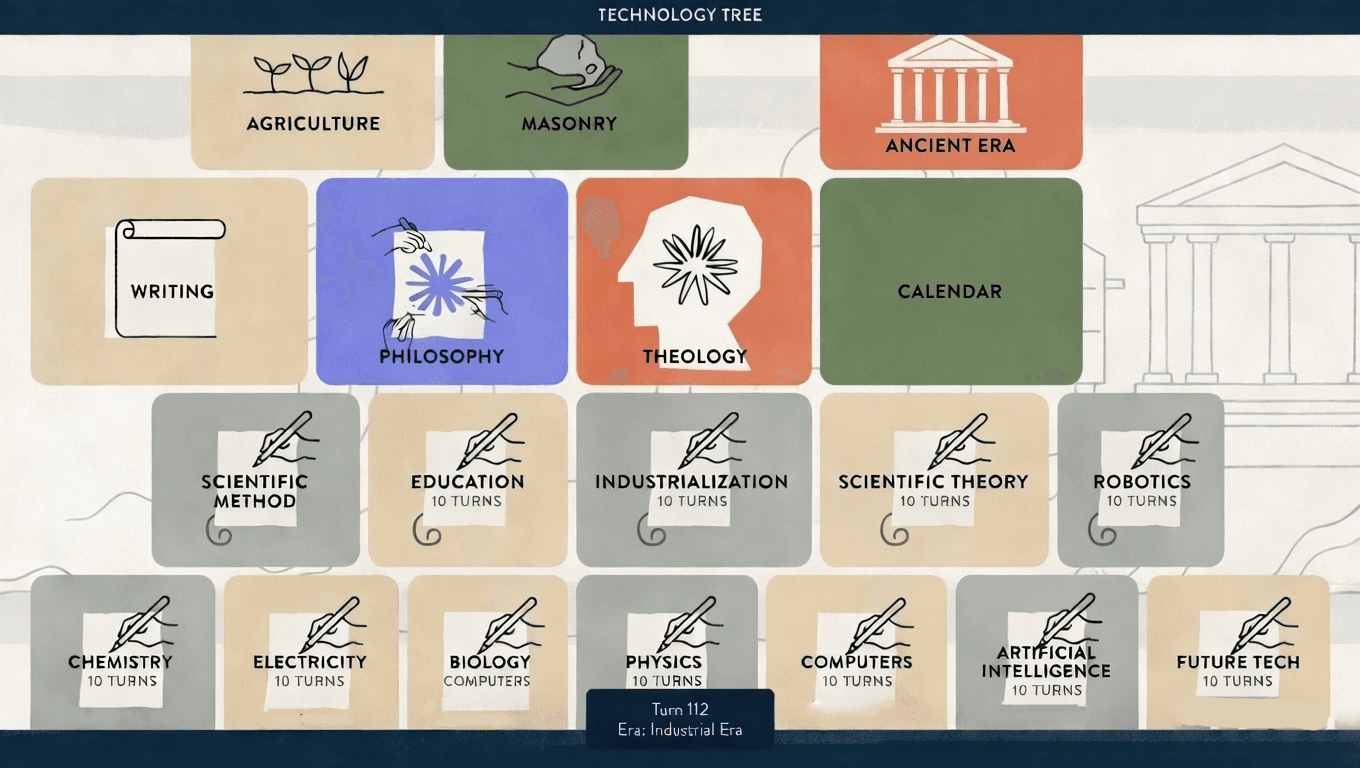
By the modern era, Civ turns slow to a crawl. Micro-management overwhelms strategy. The elegant early snowball becomes bureaucratic drudgery, and the most disciplined thing you can do is end the game.
Mature products hit the same wall. Incremental tweaks yield diminishing returns. Innovation stalls. Kaizen without purpose becomes busywork. The best product developers, like the best Civ players, know when to declare a phase over, sunset a feature, run a bold experiment, force a strategic reset.
Agentic AI turns late-game stagnation into an infinite busywork machine. The myth promises one perfect prompt will unlock breakthrough innovation. The reality is that you keep generating polished micro-iterations forever. Each one feels productive. None of them move the product forward. Human courage is still required to say “enough” and end the game.
Why agentic AI is not going to take all our jobs.
The AI industry sells the dream of the one-shot workflow and its leaders warn of the end-of-employment as we know it. Yes, there will be job losses. But Civilization shows the truth: product development is not a series of one-shot tasks. Agentic AI raises the bar for minimum viable products.
Agentic tools make every “one more turn” cheaper, faster, and more tempting. They do not eliminate the need for iteration. They make the iteration loop more addictive. They do not replace judgment, focus, or the courage to stop. They amplify the very traps that make product development hard.
That is exactly why agentic AI is not going to take all our jobs. The hardest part of the work has always been knowing when to stop iterating, when to say no to expansion, when to pivot, and when to declare a phase over. Those are still profoundly human skills.
Building the future with CivilizationAI.
I recently had the privilege to see Ray Kurzweil speak in New York. While he has been warning of AI revolutionising and automating most current jobs since the early 1990s, his optimism about a Singularity ushering in an age of unparalleled ingenuity, creativity and prosperity was still obvious at 78. Eventually we will know as a species how to live alongside super intelligence. But in the interim, as we transition to new ways of working, we need to ensure we are careful not to treat AI as an employee. As the authors of the HBR article suggest, “AI agents should be treated as what they are, software automation that requires clear human accountability for the output and operation.”
How to actually stop playing (before the game plays you).
Look, the Monday checklist is dead. Here’s the no-BS version you can actually use when the AI is whispering “just one more refinement” in your ear:
- Pick your damn victory condition upfront. One clear ship date plus one measurable outcome. Write it on a Post-it and stick it where your AI chat lives. Public shame works wonders.
- Do the 30-minute JOMT audit. Open the doc, look at it cold, and ask: “If we shipped this exact version right now, would the world actually notice?” Then kill or defer at least one thing. No mercy.
- Keep a living kill list. Not a roadmap, a list of everything you are deliberately not doing this quarter and why. Review it every planning session. The kill list is now the most important document you own.
- Force a board-state reset every quarter, independent of OKR (Objectives and Key Results) cycles. If the map you are playing changes faster than your planning cycle. Ask: “Is this still the game we’re actually in?”
- Set the stopping rule before you hit send to the AI. “Generate three options. Stop when you hit version n unless it’s genuinely better.” Give the machine guardrails before it starts feeding you endless perfect-looking drafts.
Civilization doesn’t merely entertain. It warns. The loop is stronger than individual discipline alone. Zuckerberg’s thousand hours prove that even capable, accomplished operators are not immune.
Agentic AI doesn’t break the loop. It perfects it.
The product developers who win are those who learn to end their games on their own terms rather than letting the turns, or the AI, end them.
The AI era raises the stakes. The tools will keep improving. Our ability to say enough must improve faster.