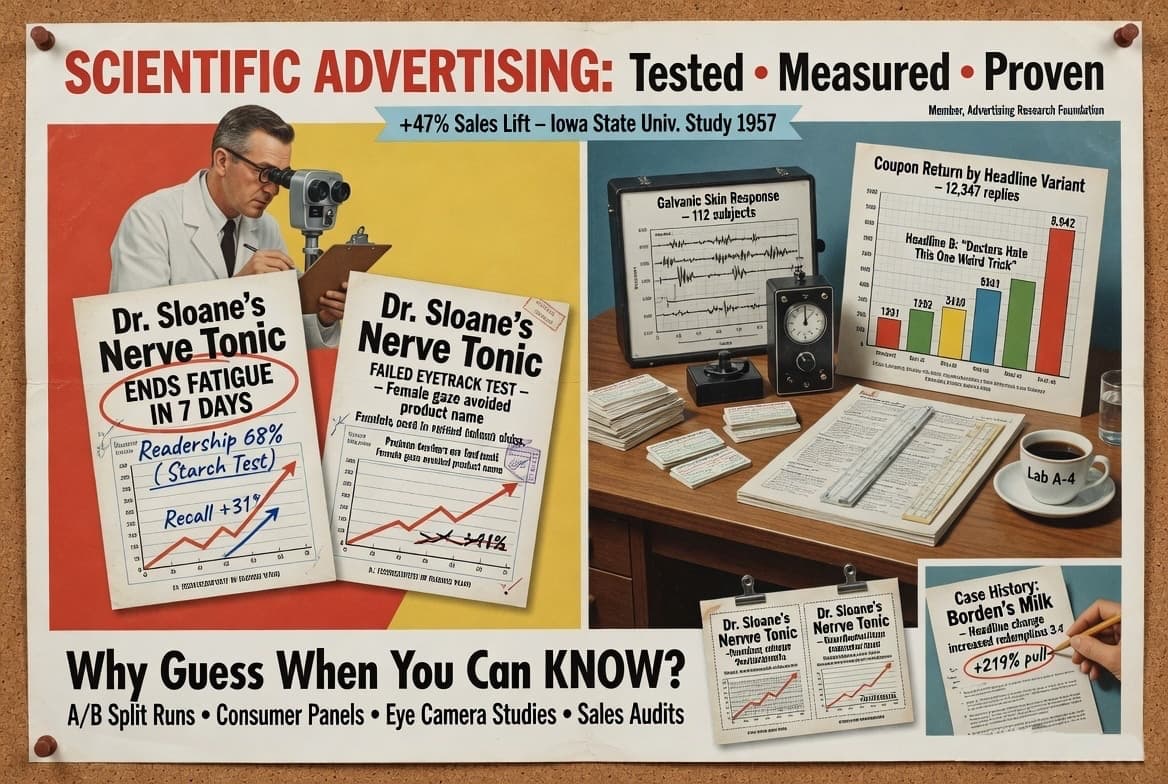
“A person who desires to make an impression must stand out in some way from the masses. And in a pleasing way. Being eccentric, being abnormal is not a distinction to covet. But doing admirable things in a different way gives one a great advantage.”
David Ogilvy famously said no one should have anything to do with advertising until they’ve read Claude C. Hopkins’ 1923 book Scientific Advertising seven times.
This is my third read in thirty years, which makes writing about it feel both premature and overdue. Scientific Advertising is unlike academic literature on marketing or the tsunduku of business books bought at airport convenience stores. Hopkins reads like scripture for modern marketers. His moral meditations sound dated, but the principles line up with what great direct response writers do today: reason-why copy, ruthless testing, deep customer psychology. His proverbs on forcing every word to prove its value are exactly what contemporary conversion copywriters like Eddie Shleyner and Joanna Wiebe advocate.
Like many of you, I’m exhausted by the AI slop parading as thought pieces on LinkedIn and repulsed by boosted Instagram posts selling snake-oil solutions to small businesses. Returning to Scientific Advertising was a relief. We instinctively avoid the braggarts, the insipid and the eccentric in equal measure. As Hopkins wrote over a century ago:
“There are winning personalities in ads as well as people. To some we are glad to listen, others bore us. Some are refreshing, some commonplace. Some inspire confidence, some caution.”
I recently gave a hand to a family member who owns a truck aerodynamics company. His business is successful, built from decades of relationship-based sales to the point where he eventually acquired his larger competitor and established a dominant foothold in their niche of the Australian market. His core product serves an essential service that saves customers thousands of dollars. Like many local manufacturers who have survived as long, what he has built is admirable. It’s a testament to his personality more than the sophistication of his marketing or the brand.
We set about on an experiment to help launch a new product range into Australia he was importing from Italy. On the surface, that sounds exotically European like Ferrari or Fendi. In reality, it’s a tough sell. The new product is a range of durable storage and compliance solutions for commercial vehicles entering a saturated Australian market. Literally, it’s a black box. A black, plastic box.
Our goal was to ensure everyone understood that it was the damn best black box on the market.
“Almost any question can be answered, cheaply, quickly and finally, by a test campaign.”
Small business people love reminding you that they are just small business people. They don’t have the time, capital or reliable cash-flow to invest in full-time marketing functions. New product lines start as low volume, impacting margin and distribution. He was hoping to hack the system by developing some new approaches and have the same ability to run test campaigns and go-to-market with the same velocity as larger companies and enterprises. In this proof-of-concept, we combined the best of Claude C. Hopkins with Claude Cowork.
In our experiment, we first created a knowledge base of basic product specifications to use as core of the test campaigns. Then we defined his SKILL.md defining different styles, proponents and customer engagement philosophy. Then, we let the agents create six completely different versions of an email for his new product line. Each version followed the style of a leading B2B copywriter or the client’s own established tone: Joanna Wiebe’s Voice of Customer approach, Chris Orzechowski’s bold sales-conversation style, Val Geisler’s warm relationship-first framework, Laura Belgray’s conversational personality copy, Eddie Shleyner’s psychology-driven specificity, and a version that drew on his own product-focused voice. All six pitched the same product with the same core facts. What differs is structure, tone, rhythm, and persuasion strategy.
Most SMEs cannot afford to produce six independent drafts because the human-hours are prohibitive. Most SMEs don’t have the awareness of different practices in email copywriting. Is this email a sales conversation, a relationship-building moment, a piece of personality marketing, or a precisely engineered conversion tool? That choice rarely happens in small business direct marketing because only one direction is ever on the table.
“One wrong piece of strategy may prohibit success. Things done in one way may be twice as easy, half as costly, as when done another way.”Claude C. Hopkins on strategy
Hopkins turned advertising into a science by insisting on testing and measurement. He didn’t have the luxury of tools that could spin out dozens of campaigns in hours, but the discipline he demanded is exactly what we were applying.
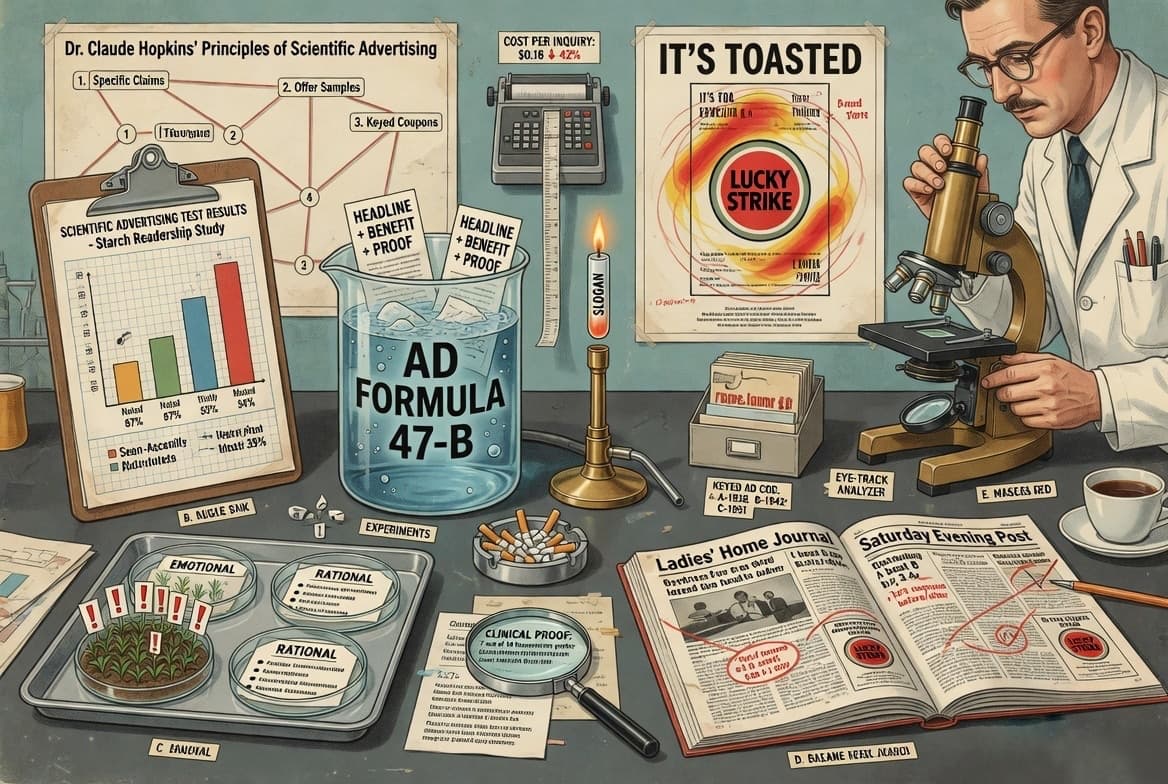
What surprised us most was how the exercise went far beyond style variations. Our agents quickly surfaced entirely new market segments for the product such as local councils, waste management operators, and mining fleet. This on top of his core truck and fleet transportation focus. It also pulled out powerful compliance features of the product range that became central selling points in several of the versions. The proof-of-concept didn’t just generate copy. It actually helped reframe the entire market opportunity for the line.
Hopkins used keyed coupons, split-run tests, and small market rollouts to let the market decide what worked. It was manual, slow, and expensive. Today we can generate and compare dozens of complete variants across different tones and audiences almost instantly, track real results in real time, and scale the winners immediately. In this project we effectively ran six different philosophies side by side and let the client see what resonated. The AI even helped discover new segments and hidden product strengths.
“Every business…receives a large number of letters. Most of them go direct to the waste basket. But they act on others, and others are filed for reference.”
Over a century later, we still make the assumption that long copy doesn’t work or won’t be read by busy customers. It’s a common view. But both Hopkins and a century of research since proved the opposite: when someone is in the market and actively looking for a solution, longer, detailed, reason-why copy that answers every objection is often what converts. Short, punchy copy has its place for cold awareness. Detailed, educational copy wins when the reader is ready to buy.
In a well-known test by Crazy Egg, a long-form landing page outperformed a short version by 30 percent because people needed more information to make an informed decision. Veteran direct response copywriter Rob Palmer, who has tracked more than $523 million in results, consistently finds long copy superior for cold traffic, complex offers, and high-ticket decisions. In one documented case long copy delivered 490 percent better conversions than short copy on the same page. The pattern holds: when education, trust, and objection-handling matter, more copy gives the reader what they need to say yes.
“Don’t be like a salesman who wears conspicuous clothes. The small percentage he appears to are not usually good buyers…Be normal in everything you do when you are seeking confidence and conviction.”
Recently I received a product update email from the Stitch team at Google announcing their biggest launch yet. It was a beautifully simple, text-heavy note using light emojis, scannable bullets, a personal greeting, and one clear call-to-action to watch a tutorial on getting the best results. No fancy hero image, no heavy HTML template, no corporate gloss. It read like a quick note from a colleague who genuinely wants you to succeed.
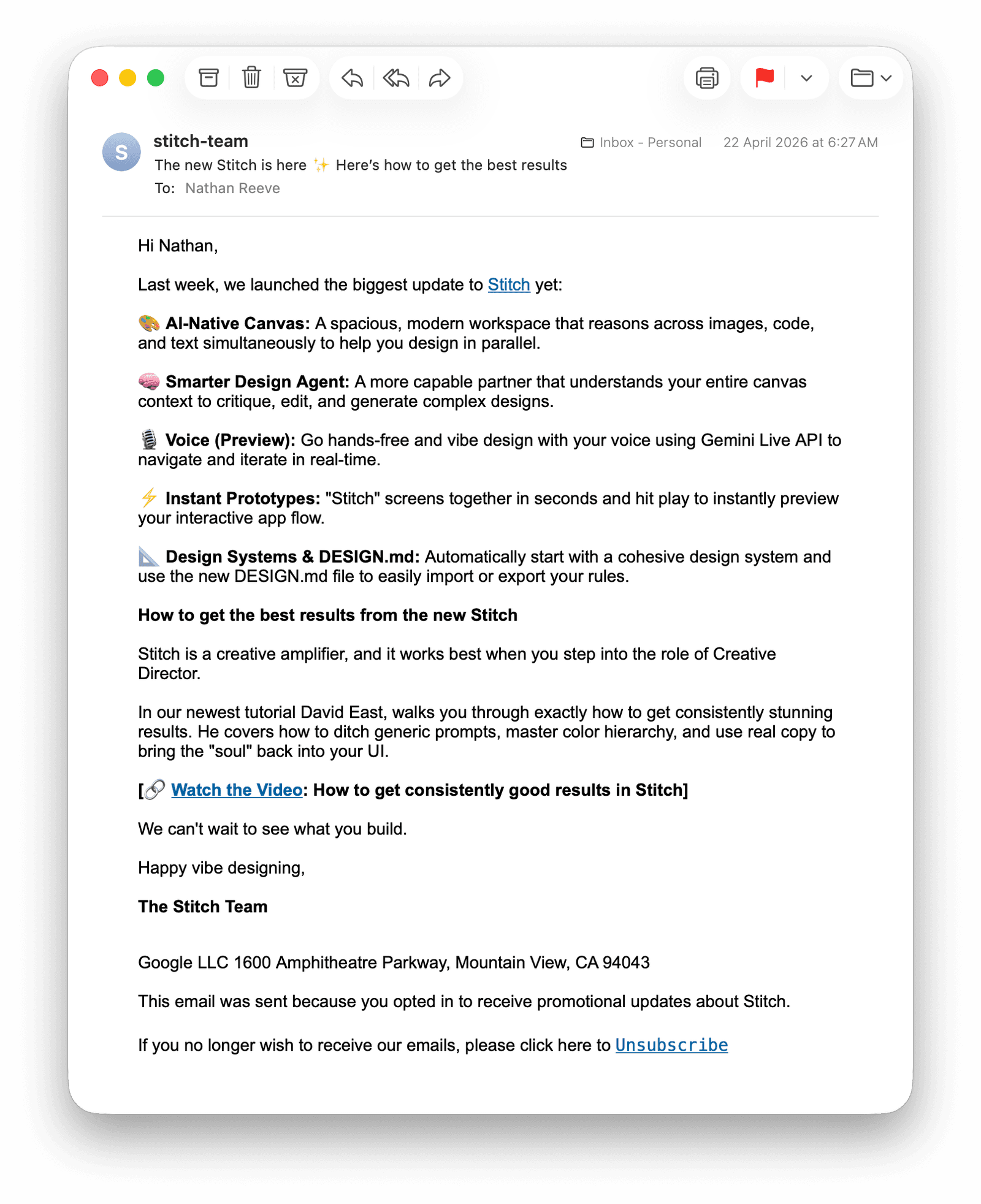
That email had the look and feel like it came straight from someone’s personal inbox or a subscriber-only mail list from Lenny Rachitsky (Lenny’s Newsletter), not a global giant. It prioritised clarity, authenticity, and value over visual polish. It’s deliberately minimal to not distract from the message. Instead, it focuses attention on the copy and the next step, exactly the kind of helpful, service-oriented communication that feels human and trustworthy. Fascinating since it was advertising the launch of a mass-market AI design tool.
The Stitch email reverts back to century-old direct-response marketing techniques: it gives useful information, frames the user as the Creative Director, and gently guides them to the tutorial without any unnecessary decoration. It’s the modern mail-order letter or newspaper coupon. It was plain, scannable, and relentlessly useful. Hopkins would have approved.
This whole experience has left me thinking about the bigger picture. Collectively, SMEs waste extraordinary amounts of money with untested material and ineffective marketing. The tools have changed enormously, but human nature has not. People still respond to clear benefits, credible promises, and proof that something will actually make their business better. The opportunity is there to use these tools with Hopkins-level discipline and modern marketing best practices. But will SMEs use their new thinking machines to explore those truths and test them with greater rigour than ever?
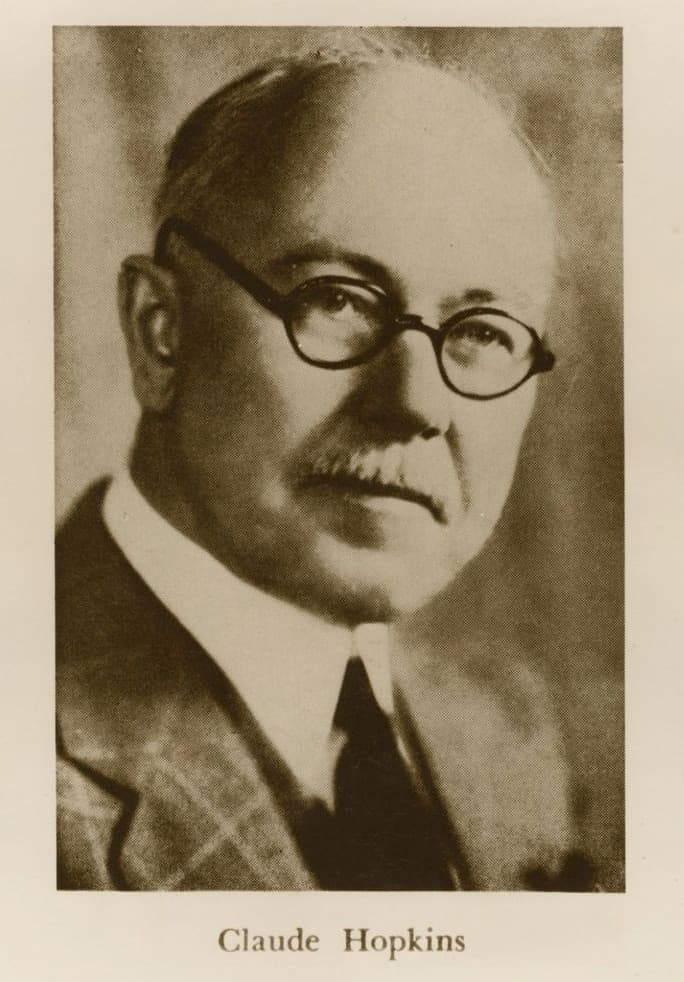
The portrait of Hopkins that often accompanies discussions of his work shows a man who saw through the noise of his own era to the fundamentals. In our time of AI abundance, that perspective feels more relevant than ever. The real power is not in letting the machines replace judgment. It is in using them to multiply the rigorous, customer-focused approach he first set down.
Hopkins loved common folk and loathed the overly-educated advertising types of his day. He would love that AI is democratising marketing at the small end of town faster than anything in the past three decades. A two-person operation can now run market research, test six campaign directions, and ship a polished email sequence in a week. Hopkins-discipline plus frontier tools. Yes, it’s not perfect. But we can’t deny that SMEs are asking themselves more sophisticated marketing questions and rolling their own.
Read Scientific Advertising. It is now in the public domain and remarkably short. Then apply your modern tools through its lens. The combination of his century-old rigour and today’s technology may be one of the strongest advantages any of us has right now.
The tools have changed. The principles have not.
And when you bring real discipline to the combination, marketing finally stops feeling like guesswork and starts operating like the effective science Hopkins always knew it could be.